From red glows on clay tablets to spacecraft flying through the Sun's corona: omens, legends, brilliant wrong ideas and the slow discovery of the truth.
For most of history the people who wrote things down lived far from the aurora. In Mesopotamia, in Greece and Rome, in China and Japan, it came only a few times in a lifetime, and almost always red: the top of a curtain hundreds of kilometres to the north, peeping over the horizon.
So the oldest records are of fires, of blood, of armies in the sky. They were kept carefully, because a sign in the heavens meant something for the king, and those court diaries are what lets us date great solar storms thousands of years later.
In the north, where the lights were part of every winter, they belonged to the stories people told instead: the next chapter.
Painting · 1865
Aurora Borealis, Frederic Edwin Church, 1865: painted from the sketches of an Arctic expedition, in the years of the American Civil War, when many read the lights as an omen.
c. 660 BC
Assyria: a red glow
Clay tablets from the court of King Esarhaddon in Nineveh report a red glow in the sky to the king's astrologers. They are the oldest records of an aurora that can be dated, around 2,700 years old.
c. 340 BC
Aristotle: chasms in the sky
In his Meteorology he describes glowing chasms, trenches and torches in the night, some of them blood-red, and tries to explain them as burning vapours.
AD 14–37
Rome: Ostia is burning
Seneca tells how, under the emperor Tiberius, the sky glowed so red that troops were sent running to help the port of Ostia, sure that it was on fire.
620
Japan: a pheasant's tail
The Nihon Shoki records a red sign in the sky shaped like a pheasant's tail: the first aurora in Japanese history.
c. 1250
Norway: the King's Mirror
A father teaches his son about the north, and the northern lights. He lists three possible natural causes and admits that he doesn't know which is right. It is the first calm, curious description from the north itself.
II
Chapter II · Stories
What the lights were
Under the auroral oval the lights were not an omen but a neighbour, and every people that lived with them gave them a name and a story. Pick one.
Lapland, the far north of Norway, Sweden, Finland and Russia
Guovssahas
the light you can hear
The lights were treated with respect, and with some fear. Children were told never to whistle, sing or wave at them, or they would come down and carry you off; people pulled their hoods up and stayed inside on bright nights. In some places they were the souls of the dead, and you didn't mock the dead.
Finland
Revontulet
the fox's fires
A fox runs across the snowy fells so fast that its tail brushes the snow, and the sparks fly up into the night sky. The Finnish word for the aurora still means fox fires, and the Arctic fox is still on the postcards.
Greenland, Arctic Canada and Alaska
Aqsarniit
the ball players
The lights are the spirits of the dead playing ball in the sky, kicking a walrus skull across the heavens. Along the Bering Sea some told it the other way round: the walrus spirits play with a human skull. Whistle, and the players might come closer.
the plains and forests of Canada
The dance of the spirits
For the Cree the lights were the spirits of those who had died, dancing in the sky, and a way for them to reach out to the living left on Earth. Many First Nations across Canada and the north of the United States tell of the lights as the dead, dancing or feasting.
the Highlands, the Hebrides, Orkney and Shetland
Na Fir-chlis
the nimble men, or the Merry Dancers
Shimmering warriors dancing and fighting in the northern sky. In the islands the red that sometimes follows them was the blood of their battles, falling to the ground. In Shetland they are still the mirrie dancers.
Scandinavia, Iceland
Norðrljós
northern light
You'll read everywhere that the Vikings saw the aurora as the light shining off the Valkyries' armour. No Old Norse saga or poem says so: the idea was put about in the 1800s. The one medieval Norse text about the lights, the Norwegian King's Mirror of around 1250, is calmly scientific: it weighs three natural causes and lets the reader choose.
the islands of Japan
Sekki, 赤気
the red vapour
In 620 the Nihon Shoki, Japan's oldest chronicle, recorded a red sign in the sky shaped like a pheasant's tail. So far south the aurora is almost always red and rare, and it was read as a warning. The great red aurora of 1770 over Kyoto was drawn and described for weeks.
Aotearoa, New Zealand
Tahunui-a-rangi
the great burning of the sky
The southern lights were the fires of ancestors who had sailed far into the icy south. They lit great fires on the ice so that their glow, reflected in the sky, would tell their families back home that they were still alive.
medieval and early modern Europe
Blood in the sky
an omen
South of the Arctic the lights came rarely, and red: armies fighting in the clouds, flaming swords, blood over the city. Broadsheets told of war, plague and the death of kings. In January 1938 a great red aurora was seen across Europe, as far as Portugal and Sicily; many took it as a sign of the war to come.
III
Chapter III · Spots on the Sun
Black marks on a perfect Sun
Chinese court astronomers logged dark spots on the Sun from 28 BC: a black vapour as large as a coin, seen through haze or at sunset. In Europe the Sun was supposed to be perfect, so the rare spot seen with the naked eye was explained away, as Mercury passing in front of it.
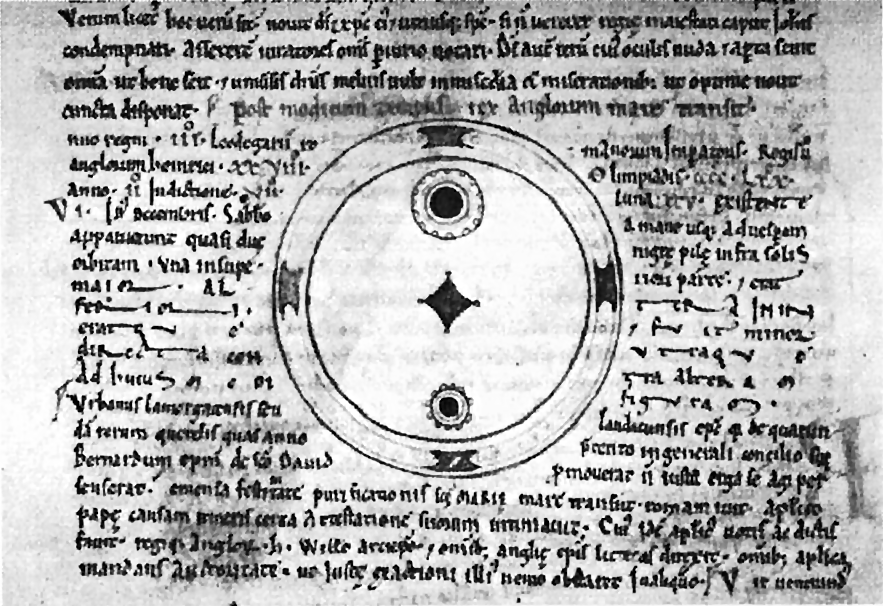
Then, in December 1128, a monk in Worcester drew what he saw: two black spots. And on the night of 13 December, half a world away, Korea's astronomers wrote down a red glow in the sky. It is the oldest pair we know of, a storm on the Sun and an aurora on Earth, recorded by people who could never have known they were connected.
Drawing · 8 Dec 1128
The oldest drawing of sunspots, in the chronicle of John of Worcester: two black spots on the Sun, seen on 8 December 1128. Five nights later, Korean astronomers recorded a red vapour filling the northern sky.
Then came the telescope
Within three years of the first telescopes, four men in four countries were drawing the spots, and arguing about them. Projected on paper, never looked at directly, the Sun turned out to be anything but perfect.
Dec 1610
Thomas Harriot
The English mathematician points one of the first telescopes at the Sun and draws its spots: the oldest drawings made through a telescope.
1611
Johannes Fabricius
A young Frisian astronomer publishes first. Watching the spots creep across the disc and come back, he guesses the Sun turns.
1611–1613
Scheiner against Galileo
The Jesuit Christoph Scheiner thinks the spots are little moons passing in front of a perfect Sun. Galileo answers in his Letters on Sunspots: they are on the Sun, they change, and the Sun rotates. Scheiner later becomes the finest observer of them all.
1645–1715
The Sun falls silent
For seventy years the spots almost vanish: around fifty in thirty years, where tens of thousands would be normal. Auroras grow rare in Europe too. Edmond Halley, after half a century of watching the sky, sees his first aurora in 1716 and finally writes about it.
Engraving · 1630
Never look at the Sun: Scheiner's helioscope throws its image through the telescope onto a sheet of paper, where the spots can be traced day after day.
Rosa Ursina · 1630
Day by day, the same groups slide across the disc: the Sun turns, once in about four weeks.
IV
Chapter IV · Explanations
How close did they get?
For two thousand years the best minds tried to explain the lights with what they had: fire, sunlight, ice, magnetism, electricity. Some were far off, some came remarkably close. Turn the cards over.
V
Chapter V · The link
The day the Sun reached the Earth
By the 1850s the clues were piling up. The compass trembled with the aurora; the aurora came and went with the sunspots. What was missing was a single moment that tied them together.
It came at 11:18 on 1 September 1859, at the eyepiece of an English astronomer, Richard Carrington. The great storm that followed is still the strongest on record, and the measure of what a really bad day on the Sun could do to a world full of electronics.
Drawn · 1 Mar 1872
An aurora drawn for science: Étienne Trouvelot's pastel of 1 March 1872, from his series of astronomical drawings for Harvard. Before photography could catch it, the aurora was recorded by hand.
1843
The cycle
Heinrich Schwabe, an amateur hunting a planet inside Mercury's orbit, counts sunspots for seventeen years and finds that they rise and fall in about ten.
1852
The same rhythm
Edward Sabine notices that magnetic storms on Earth come and go with the very same cycle; Rudolf Wolf and Alfred Gautier see it at the same time. The aurora, the compass and the Sun are one story.
Drawing · 1 Sep 1859
Carrington's own sketch of the sunspot group: the letters mark where the two beads of white light appeared and where they faded, five minutes later.
Forty hours in September 1859
A flash on the Sun, a cloud crossing 150 million kilometres in under a day, and a night when the whole world looked up. Drag through the hours.
1 Sept, 11:18 GMTthe moment of the flare
or drag through them
Two beads of white light
Richard Carrington, sketching sunspots at Redhill, south of London, sees two dazzling points of light flare up inside the group. Five minutes later they're gone. Richard Hodgson, in London, saw them too.
The needles twitch
At the same minute the magnetometers at Kew give a small jump. It was the flare's X-rays striking the upper air, though nobody could know that yet.
The cloud arrives
17.6 hours after the flare, the magnetic storm breaks: the needles swing right off their scales. A cloud of solar plasma had crossed 150 million km at over 2,000 km/s.
The sky catches fire
Auroras over Cuba, Jamaica, Hawaii and northern Colombia. In the Rocky Mountains gold miners get up at one in the morning and start cooking breakfast, sure it's dawn; in New York people read the paper by its light.
Telegraphs run wild
Sparks jump from the wires and paper tape scorches; in Washington the operator Frederick Royce is stunned when his forehead brushes a grounded wire. Between Boston and Portland they unplug their batteries and send messages for two hours on the current of the aurora alone.
One swallow
Carrington reported the flare and noted the storm that followed, but warned that one swallow does not make a summer. How the Sun could reach across to the Earth in under a day would stay a mystery for another hundred years.
VI
Chapter VI · In pictures
Painting the lights
Until 5 January 1892, when Martin Brendel took the oldest photograph of an aurora that survives, a seven-second exposure at Bossekop near Alta in northern Norway, the only way to keep one was to draw it. Explorers sketched it on deck, encyclopedias turned it into colour plates, painters travelled north to chase it. Here are some of the finest, from 1836 to the age of the polar ships. Open any of them.
Virmalised
August Matthias Hagen
An Estonian painter sets down the aurora of 6 October 1836, seen between ten and eleven at night: a sky gone red over a pale arc, and small figures looking up.
An aurora seen in Alaska
Amédée Guillemin, El mundo físico
From the Spanish edition of a best-selling popular physics: the folds of a curtain rippling straight overhead, drawn as a sea of light.
With a reindeer sledge
Coloured print, Wellcome Collection
An astronomy plate for the general reader: a reindeer sledge crossing the snow under the arc and its rays.
Northern Lights
Anna Boberg
A Swedish painter who fell for Lofoten and came back winter after winter, painting the lights in quick oil studies out in the cold. Lofoten is where Green Fairy opens too.
Njommelsaska in Lapland
Carl Svante Hallbeck
A waterfall in Swedish Lapland, travellers resting by a fire, and the lights hanging over the falls: the north as the romantic traveller dreamed it.
Sami on skis in northern lights
Frants Bøe
A Sámi hunter on skis under a pale curtain, by the Norwegian painter who spent his life on the light of the far north.
Dawson, Yukon
Library of Congress
The capital of the Klondike under the aurora, in the years of the gold rush: an early photograph, of the kind sold as a souvenir to the miners.
Northern Lights
Tom Thomson
Painted on a small wooden panel in Algonquin Park, Ontario, in the last spring of his life: the aurora as a burst of rays over the black line of the forest.
A crown over Surrey
Meyers Konversations-Lexikon
An encyclopedia plate after J. Rand Capron's sketch of the great aurora of 24 October 1870 at Guildford, England: the rays meeting overhead in a corona.
Arctic Zone
Levi W. Yaggy
A school chart of the Arctic as the nineteenth century imagined it: igloos, kayaks, seals and bears, and overhead a red and gold aurora.
Over the pines
After a pastel by M. Raebel
A coloured lithograph after a pastel: dark pines on a blue night, and the curtain rising above them in pale rays.
Over the Maud
National Library of Norway
The aurora over Roald Amundsen's ship Maud, frozen into the Arctic ice for her long drift: the lights recorded by a camera, in the middle of the polar night.
Photo · 5 Jan 1892
Bossekop, near Alta, 5 January 1892: a pale arc low over the hills, held for seven seconds on a glass plate.
1892 · The first photograph
Seven seconds of light
The plates of the nineteenth century needed minutes of light, and the aurora is faint and never still. In 1885 the Danish teacher Sophus Tromholt tried in Christiania with an eight-minute exposure; whatever he caught, he never published it.
Seven years later a German expedition led by Otto Baschin spent the winter at Bossekop, near Alta, to study the northern lights. On 5 January 1892 its photographer, the physicist Martin Brendel, opened the shutter for just seven seconds, and kept a pale arc over the hills. It is the oldest photograph of an aurora that survives.
Grainy, grey, barely there: and yet everything since, from Størmer's triangulations to the camera in your pocket, starts from that plate.
8 min
Tromholt, 1885
7 s
Brendel, 1892
1–5 s
phones today
VII
Chapter VII · The laboratory
An aurora in a glass box
In Kristiania, today's Oslo, the physicist Kristian Birkeland built a small magnetised sphere, the terrella, hung it in a vacuum chamber and fired electrons at it.
With the magnet off nothing special happened. With the magnet on, the glow gathered into two rings around the poles: the auroral ovals, decades before anyone could see them from space. Birkeland concluded that the aurora was made by particles from the Sun, steered by the Earth's field, and carried by electric currents flowing along it.
Many laughed at the currents. In the 1960s satellites flew through them: they are called Birkeland currents today. Try the magnet yourself.
Without a magnet the electrons fly straight and splash on the side facing the beam, the way sunlight falls on the Earth. Nothing like an aurora.
Magnetised, the sphere steers the electrons along its field lines: they miss the face turned to the beam and pour down around the poles, lighting two rings. Birkeland had made the auroral ovals in a glass box.
Photo · c. 1910
The real thing: Birkeland and his assistant Olaf Devik at the terrella chamber in Kristiania.
1867
One colour, one line
Anders Ångström spreads the aurora's light through a prism: the green is a single, sharp line at 557.7 nm, which matches no gas known on Earth at the time.
1899–1903
Expeditions to the Arctic
Kristian Birkeland sends teams to stations around the north of Norway, recording the magnetic storms that go with the aurora, and proposes that it's powered by electric currents flowing down from space.
1910s
How high?
Carl Størmer photographs the same curtains from two places at once and triangulates them: the lower edge is around 100 km up, the tops can pass 300.
May 1921
The railroad storm
One of the strongest storms ever measured. Currents surge through telegraph and railway lines; at Brewster, north of New York, the telegraph switchboard bursts into flames and the station burns down, and the operator is driven from his desk by the fire. Nobody was killed, but it was a warning for the electric age.
1925
The green is oxygen
In Toronto, John McLennan and Gordon Shrum make the green line glow in the laboratory: it's oxygen, in a state that only lasts in the thinnest air.
1930s
A cavity in the wind
Sydney Chapman and Vincent Ferraro show that a cloud of charged gas from the Sun would squeeze the Earth's field into a cavity: the magnetosphere, before it had a name.
VIII
Chapter VIII · The space age
From rockets to the corona
The last pieces fell into place once instruments could leave the ground. In twenty years rockets and satellites found the radiation belts, measured the solar wind, flew through Birkeland's currents and photographed the whole oval from above.
Today a fleet of spacecraft watches the Sun every minute, and a million and a half kilometres upstream two of them measure the wind before it reaches us. That is the data Green Fairy reads to tell you where to stand tonight.
From space · 11 Sep 2005
Birkeland's ring, for real: the southern auroral oval photographed from space by NASA's IMAGE satellite, four days after a record flare.
1957–58
The International Geophysical Year
A worldwide network of all-sky cameras films the aurora night after night. From those films Syun-Ichi Akasofu draws the life cycle of the substorm in 1964.
1958
Belts of radiation
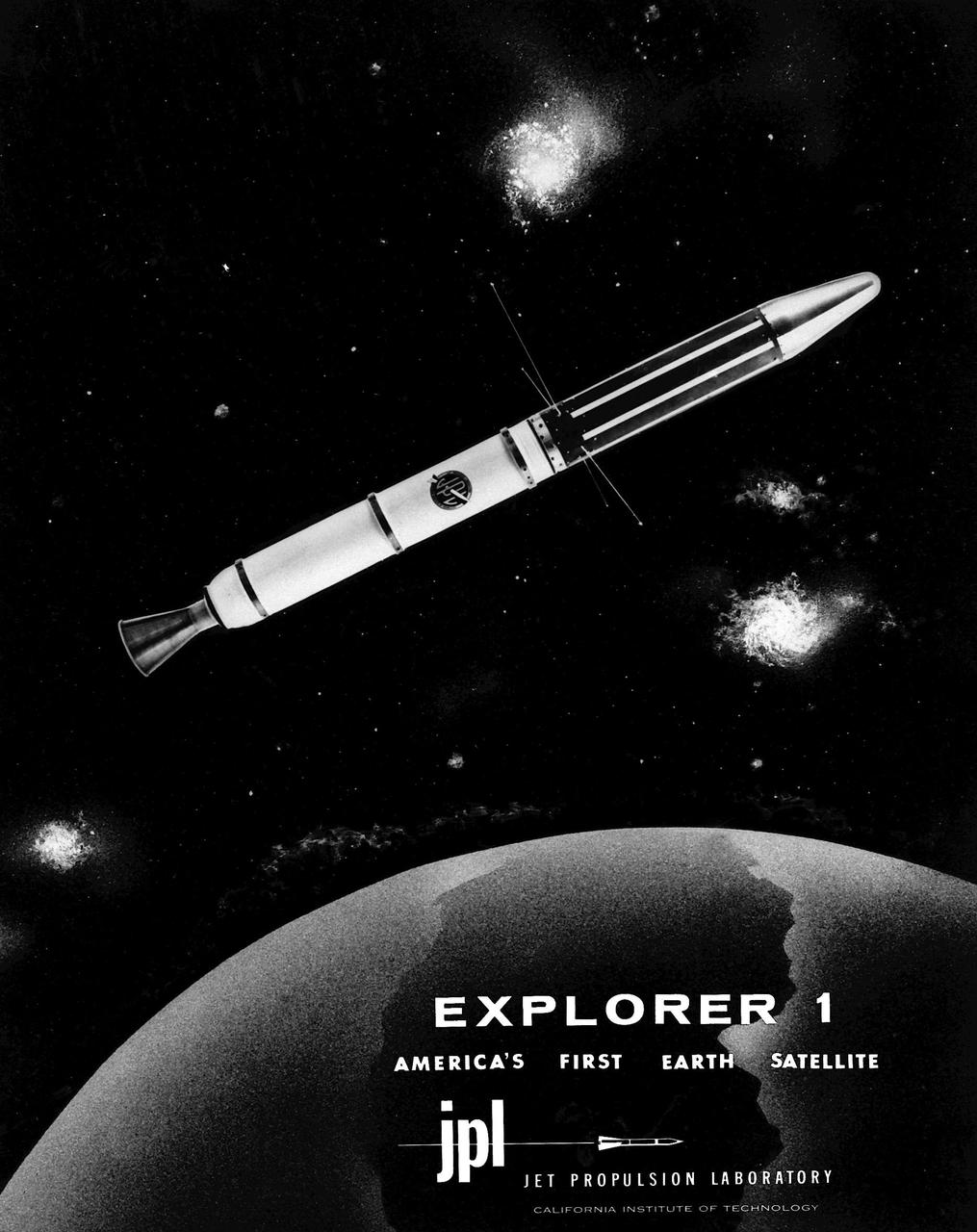
Explorer 1, the first American satellite, carries James Van Allen's Geiger counter: the Earth is wrapped in belts of trapped particles.
1958–62
The solar wind
Eugene Parker predicts that the corona must flow out into space as a supersonic wind. Few believe him, until Mariner 2 measures it on its way to Venus in 1962.
1961
The door opens
James Dungey explains how the wind's magnetic field, pointing south, joins the Earth's and lets the energy in. It is what every aurora forecast watches today: Bz.
1981
The oval from above
Dynamics Explorer 1 photographs the whole auroral oval from space for the first time: a crown of light around the pole, exactly where the theory put it.
1995–2018
Watching the Sun all the time
SOHO in 1995, SDO in 2010, Parker Solar Probe in 2018: the Sun is now watched every minute, and in 2021 a spacecraft flew through its corona for the first time.
May 2024
The great storm
The strongest geomagnetic storm in more than twenty years paints auroras from Mexico to the Canary Islands, and millions of phones photograph them. Green Fairy's forecasts are built on all of the above.
Photo · 1958
Explorer 1 held up by William Pickering, James Van Allen and Wernher von Braun after its launch in January 1958. Its Geiger counter found the radiation belts.
The story isn't finished
Twenty-seven centuries after the astrologers of Nineveh, the next great storm will be photographed by millions. All it takes is the right place, a clear sky and a little patience.
Old pictures: public-domain reproductions via Wikimedia Commons; space images: NASA. Each picture's credit is behind its ⓘ. Dates before the telescope are as given by the historical records and their modern studies.