A journey of 150 million kilometres: from a storm on the Sun to a curtain of light a hundred kilometres above your head.
⌄The Sun's outer atmosphere, the corona, is over a million degrees, so hot that the Sun's gravity can't hold it. It boils off into space in every direction, day and night, as the solar wind: a thin, electrically charged gas of protons and electrons that drags the Sun's magnetic field along with it.
It has two kinds of weather. Coronal holes, dark patches in the ultraviolet, release steady fast streams that come back every 27 days, as the Sun turns. Coronal mass ejections, CMEs, are the storms: billions of tonnes of plasma hurled out by eruptions around sunspots.
Both are the Sun's magnetism at work, and both follow its 11-year rhythm. The years just after a maximum, like these, are often the richest in big auroras.
By the time it reaches us the wind is almost nothing: a handful of particles in every cubic centimetre, thinner than the best vacuum made in any laboratory. What makes it matter is its speed, and the magnetic field it carries.
Ultraviolet light from ionised helium. The chromosphere itself is 4,000–20,000 °C; this light comes from its very top, where the temperature shoots up towards the corona's million. Prominences arch off the edge.

Only when the Moon covers the Sun does its corona show to the eye: a pearly crown of streamers, a million degrees hot, flowing out into the solar wind. Spacecraft coronagraphs make their own eclipse with a disc, to watch it, and the CMEs leaving the Sun, every day.
Madras, Oregon · 21 August 2017
Seen up close, the Sun's surface boils. Hot gas rises in granules about the size of a country (around 1,000 km across), spreads, cools and sinks back in dark lanes. Each one lives about ten minutes; some four million cover the Sun at any moment.
Where knots of magnetic field break through, they choke the boiling: less heat gets up, and a sunspot forms: around 3,800 °C against 5,500 all around, so it looks black (on its own it would still outshine the full Moon). Spots come in pairs of opposite magnetic poles, can grow wider than ten Earths and last from days to months.
A spot has two parts: the dark core, the umbra, where the field stands straight up, and the penumbra around it, a ring of filaments where the field lies down at a slant and gas streams outwards along it. Seen near the edge of the Sun, a spot looks like a shallow dip: the gas inside is so much more transparent that we see several hundred kilometres deeper.
Granules are grouped into supergranules some 30,000 km wide, slow cells that sweep the magnetic field to their edges and draw a faint network over the whole Sun. And the Sun doesn't turn as one piece: the equator goes round in about 25 days, the poles in about 35. That shear winds the field tighter year after year, until it bursts through as spots.
It's around them, where the field gets twisted and snaps, that flares and CMEs erupt: the storms that bring the aurora south.
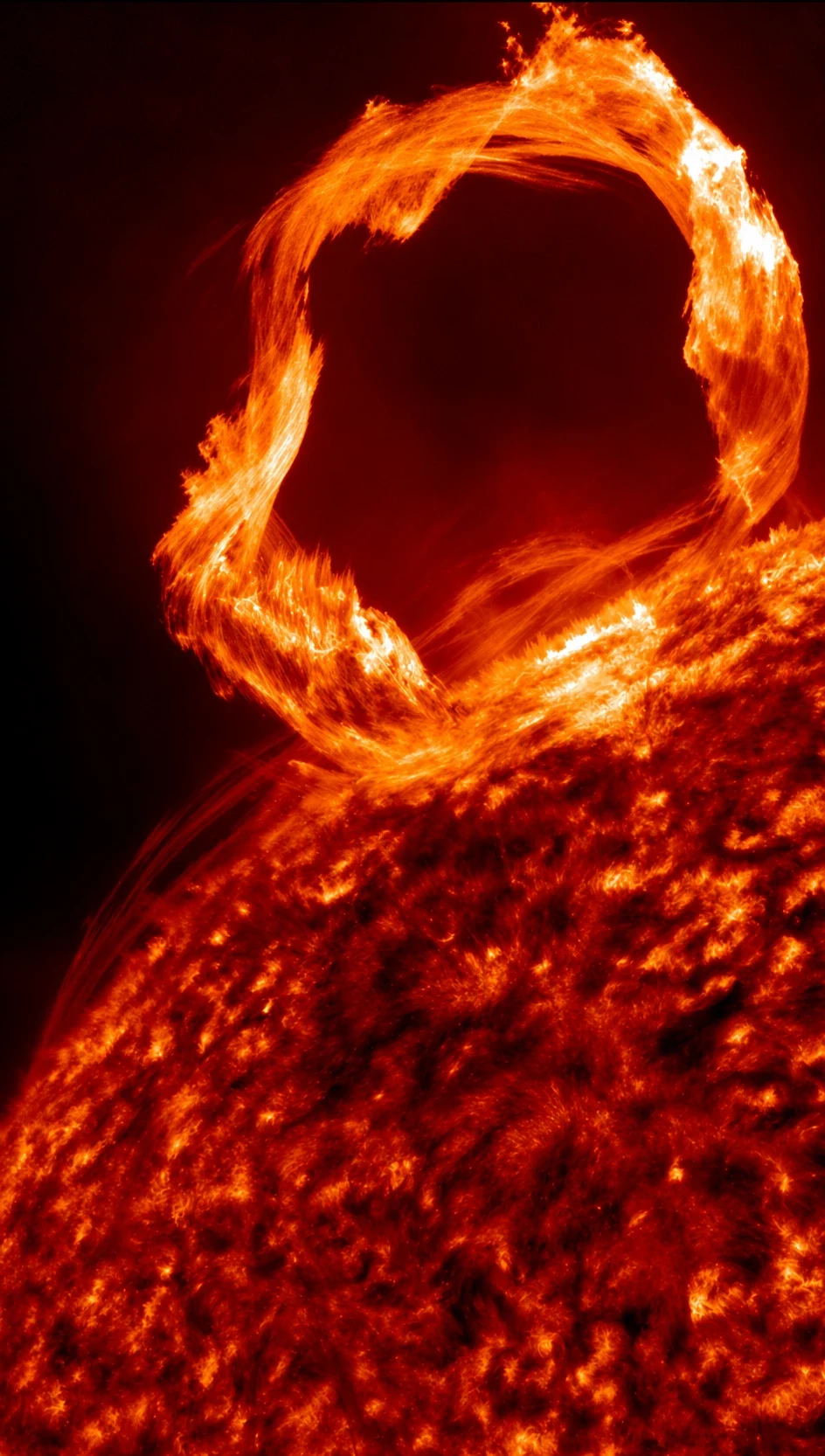
Real photo · 28 Jan 2020Above every sunspot pair the magnetic field arches from one pole to the other. The gas there is at a million degrees and electrically charged, so it can only move along the field lines, and it lights them up. As the spots drift, the loops get twisted like rubber bands; when they snap, the stored energy goes off as a flare, and often a CME.
The loops are the field made visible: plasma at a million degrees can only flow along the lines, so it lights them up, streaming up one leg, raining down the other.

The number of spots rises and falls every eleven years or so: at minimum the Sun can stay blank for weeks, at maximum it's covered in them, and its whole magnetic field flips. Each cycle's first spots appear at mid-latitudes, the last ones near the equator. They've been counted every month since 1749; Cycle 25, the 25th since then, peaked in late 2024, stronger than forecast.
Region 12192, the largest of its cycle: 129,000 km across. It fired several X-class flares in a week.
25 ultraviolet images blended: the bright loops crowd into two belts either side of the equator, where the spots of the rising cycle were born.
Heading for the minimum, the Sun went eleven days without a single spot, the first such stretch in years.
An X9.3 flare from sunspot 2673, with a CME behind it. The white streak is the instrument dazzled by the flash.
The Sun's magnetic field today: each spot group shows as a pair of opposite poles, one colour each: the knots of field that make the spots.
The everyday solar wind takes three to five days to reach us, at 300–500 km/s. A fast CME can do it in a day and a half; the most violent one on record, in September 1859, took under 18 hours and lit up skies as far south as the Caribbean.
A million and a half kilometres before the Earth, two spacecraft, DSCOVR and ACE, sit in the wind's path and measure it as it passes. That gives about 30 to 60 minutes' warning: Green Fairy reads them every few minutes, and tells you when what they see will arrive.
Speed is only half the story. What the spacecraft check first is the cloud's magnetic field: the same CME can fly past almost unnoticed or set the whole sky alight, depending on which way that field points when it reaches us. That's the next chapter.
Try it: the slider starts at the wind blowing right now. Then launch a CME.
At this speed the wind takes 4.1 days to reach us. Slow wind blows at 300–400 km/s; streams from coronal holes at 600–800 km/s.
Pick a CME and launch it: watch the shell cross the gap and hit the shield.
The Earth is a giant magnet. Its field, the magnetosphere, deflects the solar wind: squeezed to about 65,000 km on the day side, stretched into a tail longer than the distance to the Moon on the night side.
It also keeps our air: without it the wind would slowly strip the atmosphere away, as it did on Mars, which lost its global field billions of years ago.
Most of the time the wind just slides around it. But the wind carries the Sun's own magnetic field, and its north–south part, Bz, decides everything. When it points south, opposite to ours, the two fields join at the nose: the door opens. Energy pours in, piles up in the tail and snaps back in bursts called substorms, which fling electrons down the field lines towards the poles.
That's why Green Fairy watches Bz first: a fast wind with Bz north can give nothing; a modest one with Bz south for hours can fill the sky.
The door is open. The Sun's field points the opposite way to ours at the nose: the two join, the wind's energy gets in and the aurora comes alive within tens of minutes.
The falling electrons follow the field lines into two rings around the magnetic poles: the auroral ovals, some 4,000–5,000 km across. The northern lights and the southern lights, the aurora australis, shine at the same time, mirror images of each other.
The oval is lopsided: further from the pole on the night side, where the best displays happen, around magnetic midnight. When activity rises it widens and slides towards the equator. Its reach is measured by Kp, a 0–9 index built every three hours from magnetometers around the world.
The north magnetic pole sits in the Canadian Arctic, so at the same latitude North America is closer to the oval than Europe: Seattle gets auroras that Milan almost never sees.
From the ground you only ever see a slice of it. Under the oval the aurora dances overhead; a few hundred kilometres outside it, it hangs as an arc low on the horizon; further still, only the tops of the curtains show, as you'll see in a moment. On NOAA's scale Kp 5 is a minor storm, G1; Kp 9 is an extreme one, G5, which comes about four times in an eleven-year cycle, as on 10 May 2024.
The electrons arrive at tens of thousands of kilometres per second and crash into the oxygen and nitrogen of the upper atmosphere. Each collision lifts an atom to a higher energy; when it falls back, it gives the energy away as light of one precise colour. It's a neon sign, with the sky as the tube.
Height decides the colour. The sharp lower edge of a curtain, about 100 km up, is where the electrons run out of energy. Above it, oxygen glows green; higher still, where the air is thinnest, it glows red; at the very bottom, nitrogen adds a violet-pink hem.
Each colour is a fingerprint. Point a spectrometer at the aurora and you find the same few lines every time, in every country, on every night: the chemistry of the sky, read from the ground.
Mixes make the rest. Where red and green overlap the eye sees yellow or white, and the top of a curtain over a strong storm turns pink. When the electrons are very energetic, the bottom edge goes a vivid magenta: down there nitrogen molecules glow red as well as violet.
And the camera sees more than you do: its sensor doesn't lose colour in the dark, so the red and violet your eyes miss come out plainly in a few seconds' exposure (Chapter IX).
Oxygen · 557.7 nm · 100–240 km
The aurora's own colour: oxygen again, a different jump, released in under a second, so it survives where the air is denser. Our eyes are most sensitive right here, in the green: that's why most auroras look green.
Every flash of aurora is an atom giving back energy it was handed a moment before. An electron from space strikes; one of the atom's own electrons is lifted to a higher energy level; and when it falls back, the energy leaves as one particle of light, always the same colour for the same fall. Three falls make almost all of the aurora.
A fast electron from space hits an oxygen atom and kicks one of its electrons two levels up (4.2 eV). In under a second it drops one level and gives that energy back as green light, 557.7 nm. Quick enough to happen even at 100–150 km, where the air is thicker, so green is the aurora's main colour.
The Earth curves away beneath you: a thousand kilometres off, the ground under the aurora is already about 80 km below your horizon (d² / 2R: the distance squared over twice the Earth's radius). The low green, at 100–200 km, is the first to sink out of sight; the red, up at 200–400 km, still pokes above the horizon for another thousand kilometres. That's why, in May 2024, people in Italy and Spain photographed a red glow low in the north, with no green beneath it.
You see the whole curtain, green and red, from 0.3° to 16.7° above the horizon. Everything below 85 km is hidden behind the curve of the Earth.
Real life takes a little more off: mountains, haze and town lights hide the lowest few degrees, while the air bends light slightly upwards and lifts it back a touch. And the red is faint: at that distance it's usually a camera that catches it.
A good night often follows a script. In the evening, a quiet arc rests low in the north. Then, suddenly, the substorm: the arc flares up, breaks into curtains that race across the whole sky for ten or twenty minutes, sometimes into a corona right overhead. After the outburst come the diffuse glows and the pulsating patches, until dawn. On an active night the script can repeat every two or three hours.
A smooth band from east to west, low in the north, often greenish-white. It can hang for hours, or be the calm before a substorm.
The arc folds and brightens, vertical rays shoot up along the magnetic field, and the whole curtain ripples and races sideways in seconds.
Looking straight up along the field lines, the rays seem to burst from one point near the zenith: a crown of light. It's perspective: parallel rays converging.
Ghostly blotches switching on and off every few seconds, each with its own rhythm: electrons from deep in space falling in bursts.
Any planet with an atmosphere and a magnetic field to funnel particles into it has auroras, and we've now seen them on every one of the giant planets. Most glow in ultraviolet and infrared, invisible to the eye, so we know them through space telescopes and probes.
Each tells its own story: on Jupiter a volcanic moon feeds them, on Uranus and Neptune tilted magnetic fields push them away from the poles, and on Mars, which has almost no magnetic field left, a solar storm can light up the whole night side at once.
Our own, seen from above: a green band hugging the planet's edge, photographed from the Space Station 415 km up as it passed over Ukraine and Russia, January 2019.
The strongest in the Solar System, and never off. Its fuel isn't so much the Sun as Jupiter's own 10-hour spin and its volcanic moon Io, which pours about a tonne of gas a second into the magnetic field. Io, Europa and Ganymede even leave their own bright footprints in the oval.
The aurora (blue) circling the north pole, seen in infrared from orbit; red is the planet's own heat escaping, with storm clouds in silhouette. Like Jupiter's, it's driven by both the solar wind and Saturn's fast rotation.
Mars lost its global magnetic field billions of years ago, so storm particles hit its whole atmosphere: a solar storm made the entire night side glow (right), 25 times brighter than before. In March 2024 the rover Perseverance saw, for the first time from the ground of another planet, a faint green aurora.
Its magnetic field is tilted about 60° from its spin axis and off-centre, so the auroras (the white patches) wander across the planet instead of ringing the poles.
Voyager 2 caught hints in 1989; in 2025 the James Webb telescope finally saw them, in infrared. Its magnetic field is tilted almost 50° and off-centre, so they glow at middle latitudes rather than around the poles.
In the dark the eye switches to its rods: very sensitive, but colour-blind. A faint aurora looks like a pale grey cloud that won't stay still, while the camera, collecting light for seconds, shows it bright green. Red, up high, is almost always for cameras only.
A strong display is another story: green and pink to the naked eye, moving faster than any photo can tell.
All live, right now, from NOAA's Space Weather Prediction Center, the same ones behind every forecast on this site.
The door of the shield. Negative (south) opens it; the more and the longer, the better.
How hard the wind blows. Above 500 km/s it delivers more energy, if the door is open.
How thick the wind is. A sudden jump often marks the front of a CME.
How disturbed the Earth's field is, 0–9. In the Arctic 2–3 is plenty; at 5+ it's a storm.
The energy the particles pour into the northern sky. Over 50 GW the oval is bright; over 100, a storm.
Tap a card to turn it over.
Green Fairy puts all of this together for any place (space weather, clouds, darkness, the Moon, the roads) and tells you where to stand tonight.
Live images: NASA / SDO (AIA, HMI) and ESA & NASA / SOHO (LASCO). Live solar wind, magnetic field, Kp and hemispheric power: NOAA SWPC, from DSCOVR and ACE. Coastlines: Natural Earth. Photos: Green Fairy hunters. Illustrations and simulations are simplified for clarity.